
Choosing kitchen utensils in 2026 is no longer just about comparing prices online. The market is shifting towards more sustainable ranges, materials without synthetic coatings, and a marked return to purchasing in specialized stores. This context alters the selection criteria, especially when looking to buy locally rather than on a marketplace.
Uncoated kitchen utensils: what the health shift concretely changes
The issue of synthetic coatings on utensils and pans is no longer confined to activist circles. Brands like Purcook have been publishing content focused on “healthy utensils” since spring 2026, highlighting wood, glass, and iron as accessible alternatives. This trend reflects a real demand from consumers.
In practice, this means that physical stores, hardware stores, organic shops, or bulk grocery stores are increasingly stocking utensils free from PTFE or PFOA. For a local buyer, the question is no longer “where to find a wooden spatula” but rather “which store near me offers a consistent range, from whisk to iron skillet.”
This health shift has an interesting side effect: it encourages looking at composition before design. Before purchasing an attractive utensil set, checking if the material withstands cooking heat and is compatible with your non-stick or stainless steel pans remains a priority. A recent guide lists utensils on L’Art du Goût based on these regional criteria.
Stainless steel, wood, or silicone: choosing the right material for your cooking

Online competitors often list materials without hierarchy. Field feedback varies on this point, as the “best” material directly depends on the type of cooking practiced and the surfaces of your pans.
Stainless steel remains the most versatile choice. It withstands high temperatures, does not react with acidic foods, and is dishwasher safe without degrading. For stainless steel or cast iron pans, it is the logical material.
Wood is suitable for non-stick coated pans: it does not scratch the surface and feels pleasant in hand. However, it requires regular maintenance (food oil, air drying) and does not hold up well in the dishwasher over the long term. A poorly maintained wooden utensil can crack within a few months.
Food-grade silicone has gained ground in recent years. Its flexibility makes it useful for spatulas and baking spoons. Two limitations to be aware of:
- Heat resistance varies greatly from one manufacturer to another. Low-quality silicone can deform when in contact with a very hot pan.
- Silicone does not allow for gripping or scraping: it slips on smooth surfaces, making it useless for deglazing or flipping a piece of meat.
- Its durability depends on the quality of the molding. Utensils with glued handles (rather than molded as one piece) often break at the junction.
Buying kitchen utensils near you: the advantage of physical stores
The market for enameled utensils is experiencing steady growth, driven by a movement already perceptible: urban households are buying more in specialized stores than in supermarkets. The upgrade in quality pushes consumers to handle products before purchasing.
Buying locally also facilitates the availability of replacement parts and access to after-sales service. A knife with a loose handle, a pot handle to replace, a broken lid: when the brand is well established at a local retailer, the replacement can be done in a few days. On a marketplace, the same issue often means having to repurchase the entire item.
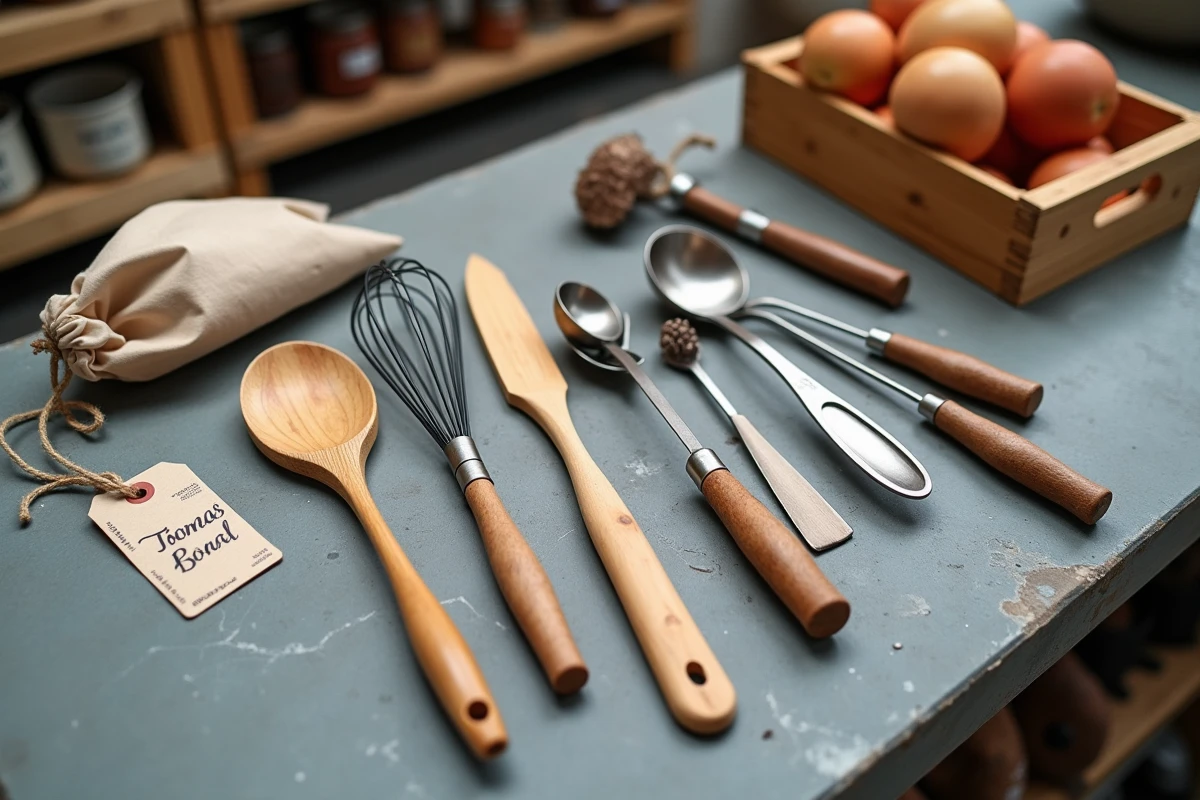
To identify the best points of sale nearby, three types of shops deserve a visit:
- Traditional hardware stores, which often stock French brands of stainless steel or iron utensils, with a supply of spare parts.
- Organic shops and bulk stores, increasingly offering ranges of kitchen accessories made from wood, glass, and untreated materials.
- Specialized tableware or dishware retailers, which allow for comparing finish quality and weight in hand, two criteria impossible to assess online.
Quality criteria for utensils: what can be checked in-store and not on a product sheet
A kitchen utensil is judged by touch as much as by reading its specifications. The weight and balance in hand determine daily comfort of use. A knife that is too light tires the wrist over time, while a utensil that is too heavy discourages use.
The finish of welds, rivets, and joints between the handle and the active part reveals the product’s durability. On a stainless steel utensil, a visible and irregular weld indicates low-quality assembly. In-store, it is enough to run a finger over the junction to feel any roughness.
The diameter and length must match the size of your pans and pots. A utensil that is too short forces the hand closer to the heat source. An oversized utensil becomes cumbersome in a standard drawer. These proportions cannot be guessed from an online photo.
Last point to check on-site: actual dishwasher compatibility. The mentions “dishwasher safe” on product sheets sometimes only cover the top rack at low temperatures. In-store, the seller can specify the exact care conditions, avoiding unpleasant surprises after a few washes.
The choice of kitchen utensils in 2026 relies less on the brand than on the consistency between the material, the type of cooking, and the ability to touch the product before purchase. Checking weight, finishes, and compatibility with your equipment remains more reliable in-store than on a screen.