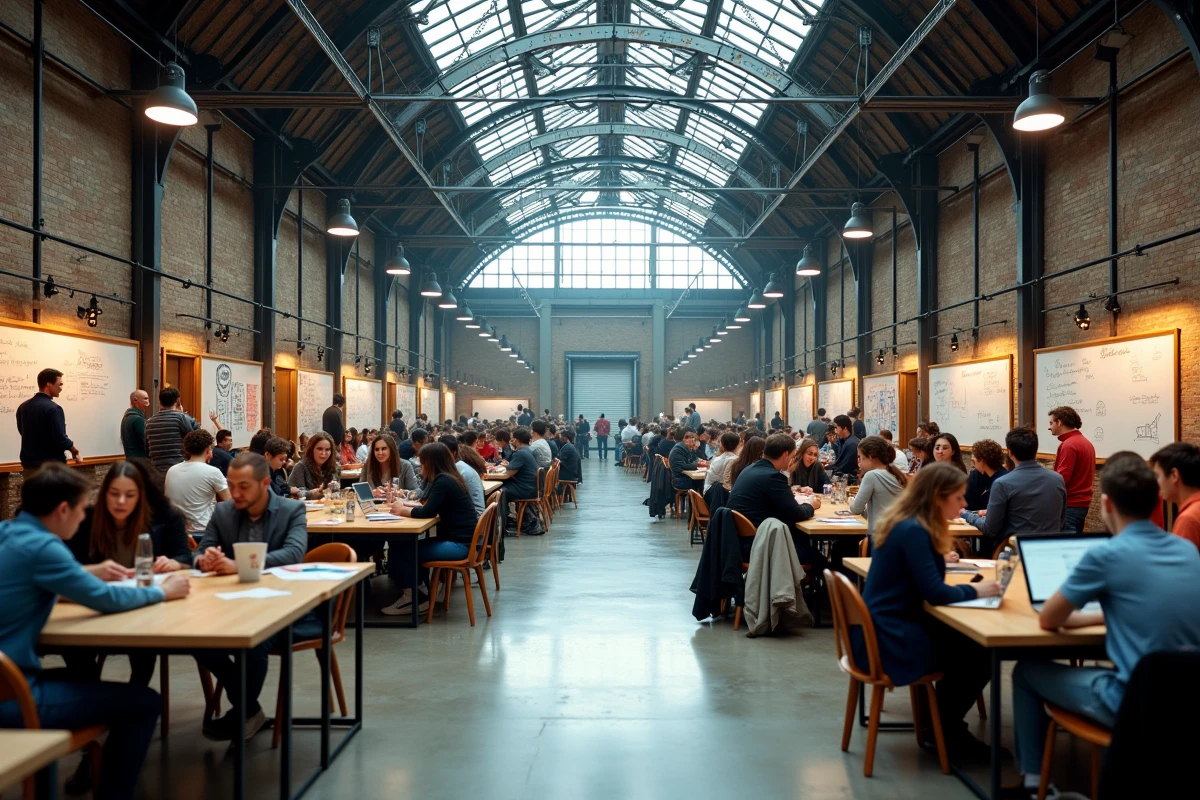
When you arrive at 5 Parvis Alan Turing, in the 13th arrondissement of Paris, the first thing that strikes you is not the size of the building. It’s the noise. A constant buzz of conversations, keyboards, and improvised pitches between two shipping containers converted into meeting rooms. Station F occupies a former railway hall from the 1920s, the Halle Freyssinet, transformed into a campus dedicated to start-ups under the impetus of Xavier Niel.
What the daily logistics of Station F hides
Station F is often talked about as a symbol of French innovation. On the ground, it is primarily a logistical machine. The campus hosts over a thousand start-ups, spread across an open space divided into work zones, event areas, and dining options. Architect Jean-Michel Wilmotte preserved the original concrete and industrial structures, giving the place a raw atmosphere, far from classic glass offices.
Specifically, each resident start-up has a workstation, not a closed office. The model relies on density and proximity: you encounter teams working on fintech, healthtech, or cybersecurity within just a few meters. Feedback varies on this point, with some founders appreciating the constant stimulation, while others find the noise level difficult to manage over time.
For those who want to discover Station F in Paris on L’Essentiel Pro, a detailed guide covers access conditions, available programs, and practical steps to apply.

Incubation programs at Station F: how selection works
Station F does not manage all its programs itself. The campus hosts about thirty partner programs, run by companies (Facebook, Microsoft) or institutions. Each program has its own selection criteria, duration, and support. The campus provides the infrastructure, while the partners provide mentorship and sometimes funding.
Applying does not guarantee an office: selection remains competitive. Start-ups apply to the program that corresponds to their sector or stage of development. A project in the seed phase does not join the same path as a start-up that is already funded.
The Fighters program, a specificity of Station F
Among the initiatives unique to the campus, the Fighters program targets entrepreneurs from disadvantaged backgrounds or refugees. This program offers free support and full access to the campus resources. It is an area that few comparable campuses offer at this scale.
Station F and foreign universities: the international shift of 2026
Since 2024, Station F has increasingly positioned itself as a bridge between international innovation ecosystems and Paris. The most concrete signal came in 2026 with the launch of a summer internship program in partnership with the University of Chicago. This program places 25 undergraduate students in 16 Parisian start-ups based on the campus.
The sectors covered by these internships give a clear idea of the current orientation of the campus:
- Artificial intelligence and deep tech (genomics, content moderation, cybersecurity)
- Climate tech and forest management, with start-ups using predictive models
- Fintech, govtech, and edtech, sectors that are actively recruiting among international profiles
This partnership is explicitly described as linking the innovation ecosystems of Chicago and Paris. For Station F, the goal is to go beyond the role of a local incubator to become a platform for exchanges between global hubs.
AI and deep tech orientation: what the list of resident start-ups reveals
The composition of the start-ups hosting Chicago interns in 2026 is not anecdotal. There is a clear overrepresentation of projects related to applied artificial intelligence. It is no longer the generalist campus of the early days, focused on consumer digital.
Station F now attracts projects with a strong technical component, led by engineers and researchers. Connected health, cybersecurity, algorithmic private equity: the topics addressed by current residents require sharp skills and longer development cycles than classic mobile applications.
A campus that filters by sector, not just by stage
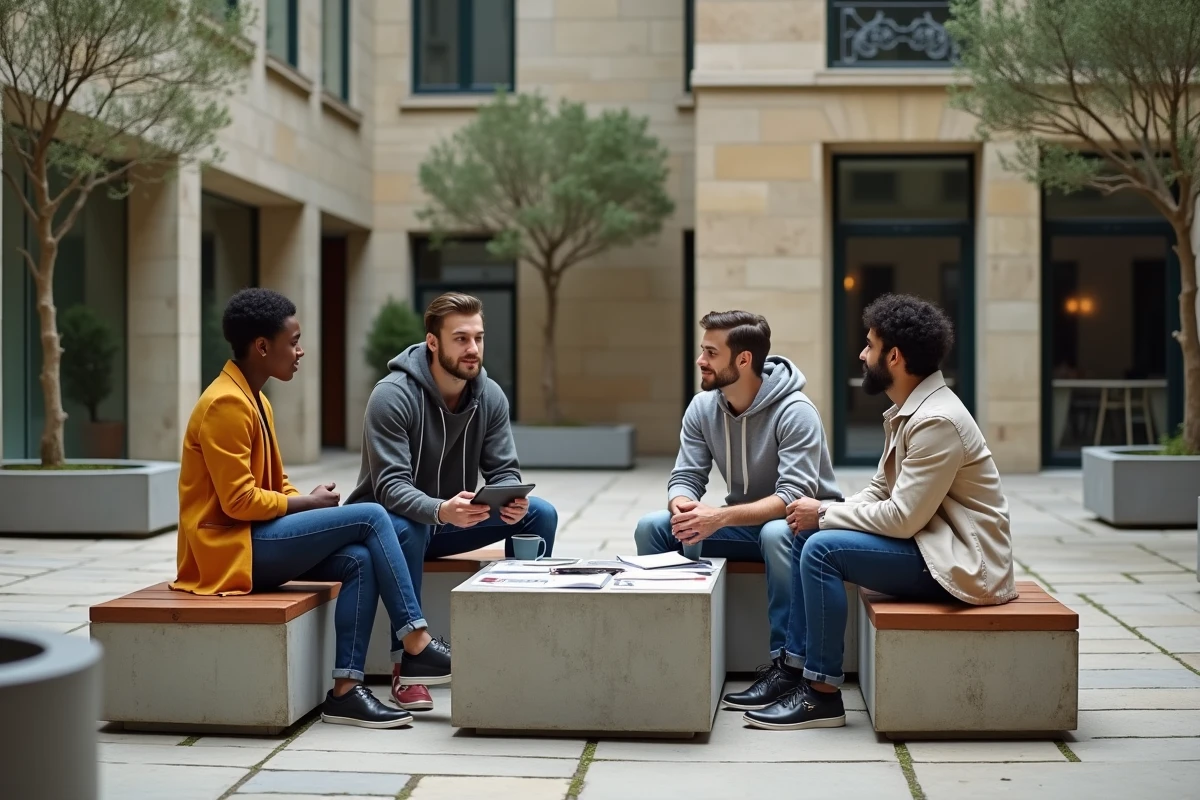
This evolution also changes the profile of the candidates. Entrepreneurs arriving at Station F in 2026 are not all T-shirt-wearing developers with an app idea. You encounter PhDs in computational biology, specialists in climate modeling, former public lab researchers. The campus reflects a broader trend in the Parisian start-up ecosystem, which is moving up the technical scale.
Access, costs, and daily life on the Paris campus
Station F is located near the François-Mitterrand Library, in a rapidly transforming area of the 13th arrondissement. The campus has restaurants, a bar, event spaces, and even a residential area for founders moving to Paris without housing.
The cost of a workstation depends on the integrated program. Some partner programs cover all expenses, while others require a monthly contribution. Access to the campus is not open to the public: you must be a resident, guest, or participant in an event to enter.
- The campus operates on individual badges, with extended access hours
- Regular events (demos, conferences, recruitment sessions) punctuate the life of the place
- Common areas encourage informal meetings, which remains the main asset cited by residents
Station F is not a classic coworking space. It is a closed, selective ecosystem that focuses on the concentration of talent and resources to accelerate tech projects. The recent shift towards deep tech and international university partnerships shows that the campus is no longer just hosting start-ups: it is actively structuring connections between research, training, and entrepreneurship on a global scale.