
A wall hook placed in the right spot changes the dynamics of an entryway in just a few seconds. Hanging your coat on a hook instead of on the back of a chair is a simple gesture, but it requires choosing the right model. The type of wall, the expected load, the style of the room, and your status as a tenant or owner influence the decision.
Rental wall hook: fix without drilling or leaving marks
Do you live in an apartment and your lease prohibits drilling into load-bearing walls? This situation applies to a large number of households, and solutions for fixing without drilling deserve serious attention.
Since 2025, modular and magnetic models have multiplied. Drill-free hooks that can be repositioned at will allow you to reconfigure an entryway or hallway without leaving a trace. High-strength adhesive systems hold on tiles, glass, or lacquered metal. On a standard painted wall, removable adhesive strips (like Command 3M) support moderate loads, which are more than sufficient for a bag or a light jacket.
To consult a practical guide on Wiki for Home, you will find a detailed comparison of fixing solutions suitable for each type of surface.
If you plan to hang winter coats or heavy bags, reinforced suction cup hooks or magnetic rail hooks offer better support than simple adhesive hooks. Test the maximum load with a weighted bag before hanging anything fragile underneath.
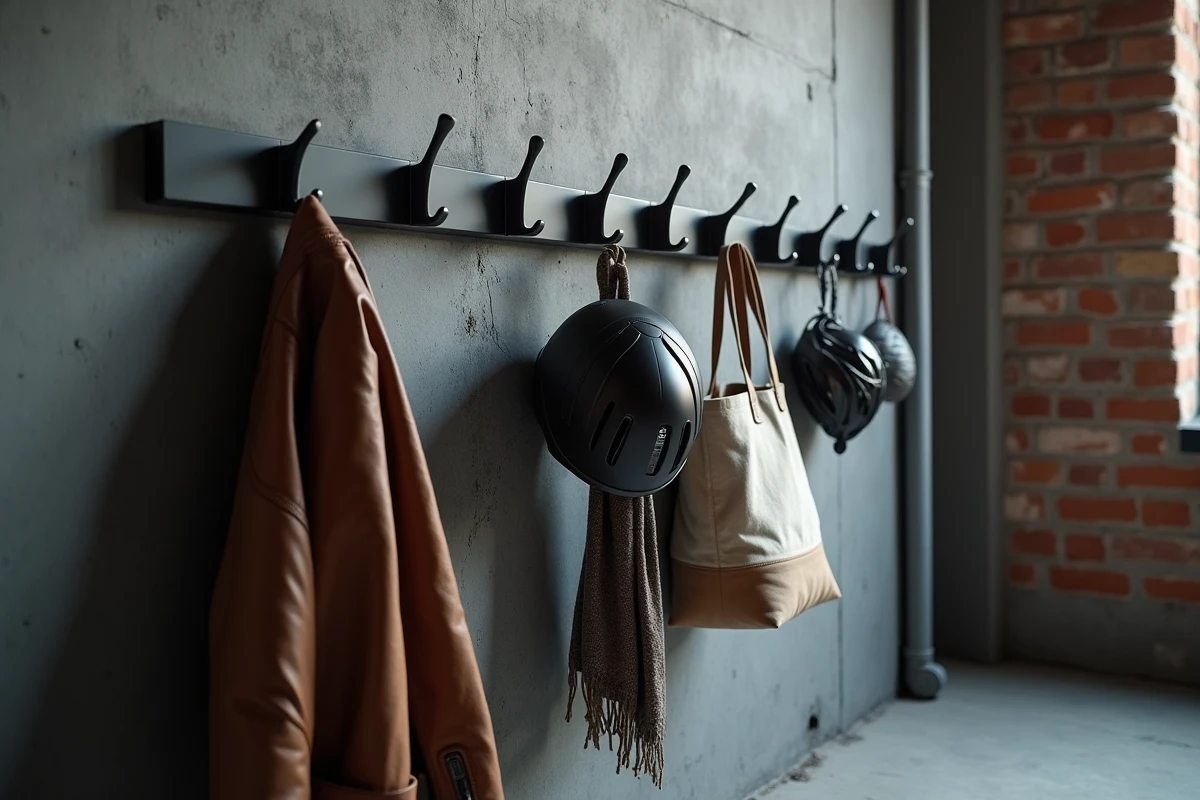
Hook materials: wood, metal, or resin depending on the room
The material of a hook determines both its strength and its decorative effect. It also affects its durability depending on the environment where you install it.
Solid wood or recycled FSC-certified wood
Wood remains the most common choice for an entryway or bedroom. It adds visual warmth and matches most styles, from Scandinavian to rustic.
According to a UFC-Que Choisir study published in October 2025, recycled FSC-certified wood generates fewer complaints related to oxidation than metal in humid environments. For a bathroom, treated wood withstands moisture better than one might think, provided you choose suitable species (teak, bamboo).
Painted or raw metal
Metal (steel, brass, aluminum) suits industrial or contemporary decor. The European regulation EN 16890:2024 now requires enhanced shear resistance testing for painted metal models, which has eliminated the least reliable products from the market. A raw metal hook generally supports higher loads than a wooden model of the same size.
Resin and composite materials
Less noble in appearance, resin hooks offer a practical advantage: they do not rust and do not deform. This is a relevant choice for a bathroom or toilet where humidity is constant.
- Entryway or bedroom: prioritize wood for aesthetics and versatility of styles
- Bathroom: choose stainless steel, teak, or resin to withstand moisture
- Kitchen or laundry room: lacquered metal or aluminum is easy to clean and supports aprons, dish towels, or reusable bags
Choosing the design of a wall hook according to your decor style
You may have noticed that a hook that is too discreet disappears on a busy wall, while a model that is too eye-catching overwhelms a narrow entryway? The size and shape of the hook should respond to the proportions of the wall, not just to your tastes.
On a white and clear wall, a designer hook in a geometric or animal shape becomes a decorative element in its own right. On a wall that is already dressed (wallpaper, gallery of frames), a minimalist hook in brass or matte black integrates without overcrowding the space.
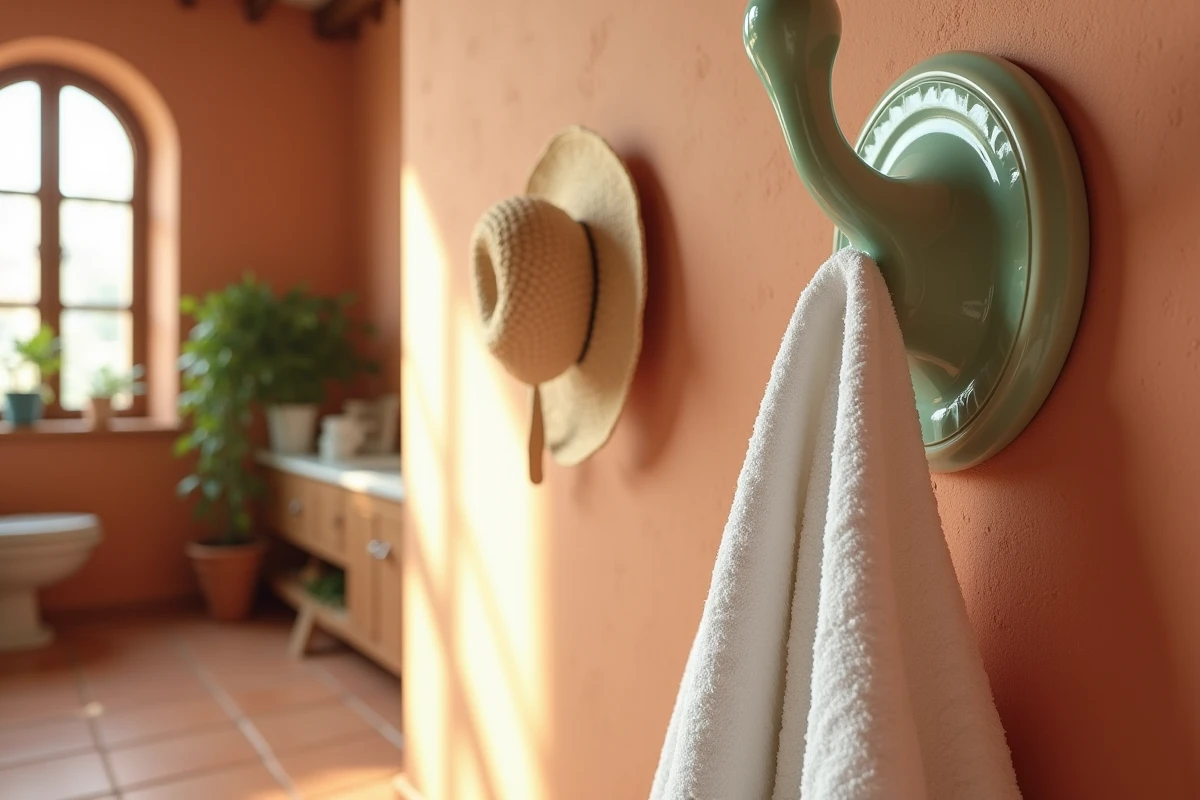
The current trend leans towards aligned sets of hooks rather than a single hook. Three to five regularly spaced hooks on a raw wood board create an organized wall storage effect. This format works particularly well in narrow entryways where a freestanding coat rack would be cumbersome.
For a child’s room, playful-shaped hooks (cloud, star, animal) serve as much to hang pajamas as to dress a wall. Choose models with rounded edges to avoid any risk of injury.
Anti-vibration wall hook: an overlooked criterion in condominiums
If you live in an apartment, noise transmitted through adjoining walls can become a sensitive issue. Hanging a heavy coat on a metal hook screwed into a thin partition produces a dull thud that the neighbor can clearly perceive.
User feedback in condominiums, documented on the Leroy Merlin forum (thread updated in April 2026 with over 150 testimonials), highlights the usefulness of hooks equipped with anti-vibration pads. These small silicone or rubber tips, placed between the hook and the wall, absorb the impact.
- Models with felt or silicone pads reduce contact noise
- Hooks with rail fixation (rather than a single screw) distribute the load and decrease vibrations
- In drywall partitions, a Molly anchor with a rubber washer isolates better than a standard anchor
Anti-vibration pads add a few euros to the price of a hook, but they eliminate the dull thuds transmitted through thin partitions, especially in the evening or early morning.
The choice of a wall hook comes down to three concrete considerations: the fixing method suitable for your wall and lease, the material suitable for the room, and the shape suitable for the available space. In an entryway of less than three square meters, two or three well-placed hooks free up as much space as a small storage unit.