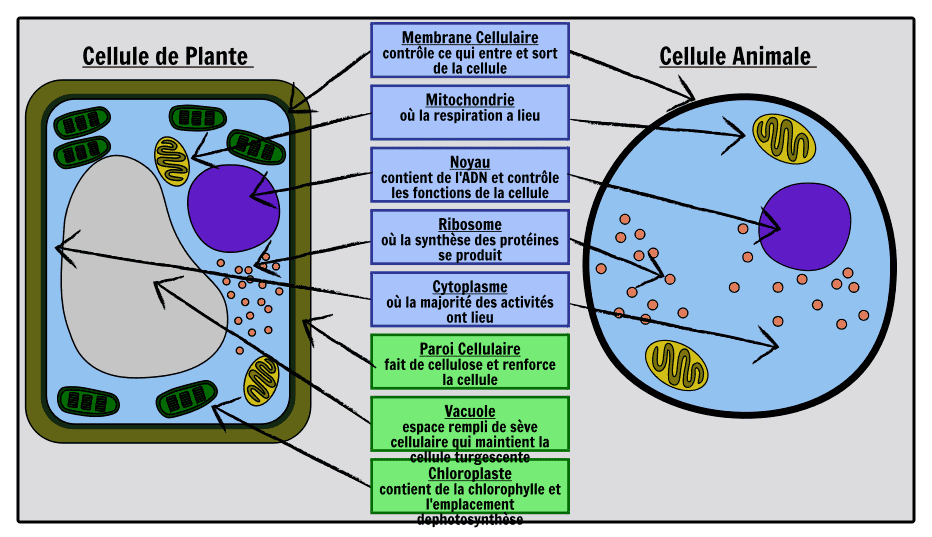
The plant cell and the animal cell can be differentiated by the presence of organelles in these cells. Although both are classified as eukaryotes, the presence of cell walls, vacuoles, and chloroplasts are the most remarkable and distinctive components of plant cells that are absent in animal cells. The size of the animal cell is smaller than that of the plant cell.
Cells exist in an astonishing variety of sizes and shapes. Similarly, in living organisms, the individual cells that form the body can grow, reproduce, process information, and respond to stimuli. Despite the differences between various types of cells, whether they are plant or animal, unicellular or multicellular, they all share certain common characteristics and perform different and complex processes in the same way.
Multicellular organisms contain billions of cells organized in a complex manner, while unicellular organisms consist of a single cell. However, even unicellular organisms will define themselves by exhibiting all the remarkable properties that a cell needs to become a fundamental and structural unit of life.
Article content
- What is a plant cell?
- Functions of important cellular organelles
- Different types of plant cells
- What is an animal cell?
- Functioning of the animal cell
- Different types of animal cells
- Main differences between plant and animal cells
- Common points between animal cells and plant cells
What is a plant cell?
Plants are made up of living eukaryotic multicellular organelles, which are autotrophic by nature. This means they are living beings capable of feeding primarily on mineral substances. As mentioned above, plant cells such as chloroplasts, the cell wall, and vacuoles distinguish them from animal cells. So far, about 400,000 plant species have been identified, and there is still much to discover, especially in the Amazon.
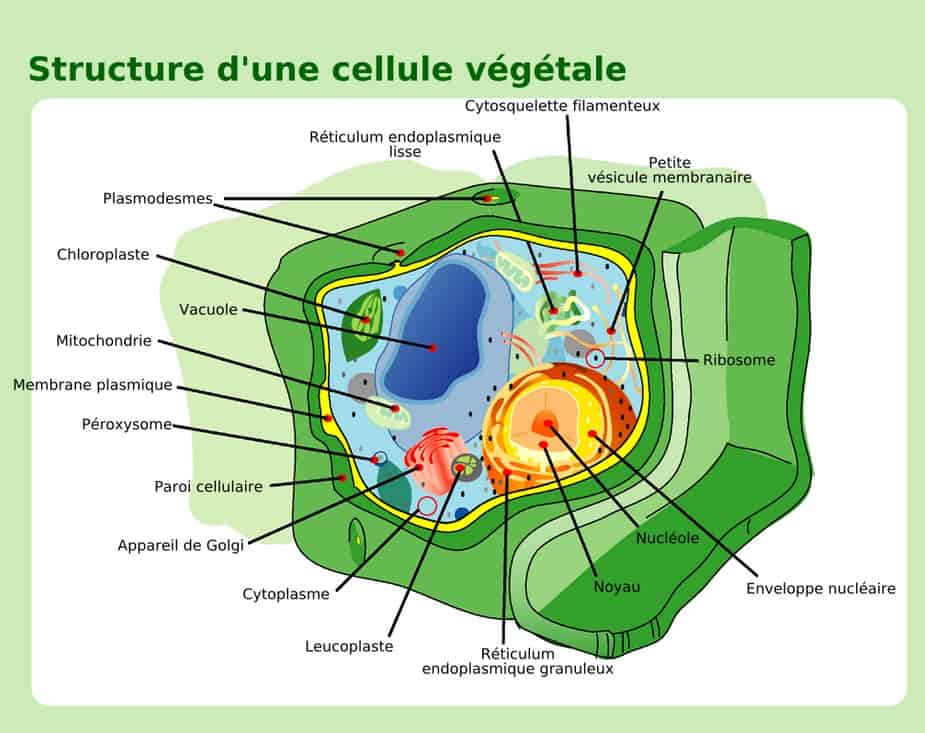
The size of plant cells varies from 10 to 100 µm. The plant cell performs the function of Structure diagram of a plant cell Photosynthesiscell wall is made of cellulose, which is why green plants are called autotrophs. This is done by the presence of chlorophyll in the chloroplasts of plant cells. The cell wall provides support and rigidity to the cells.
Functions of important cellular organelles
The plasma membrane controls the movement of molecules in and out of the cell and also ensures adhesion.
The cell wall is generally rigid, non-living, and permeable, surrounding the plasma membrane. There are two types of it: the primary cell wall and the secondary cell wall. The primary cell wall is made of cellulose, while the secondary cell wall is composed of lignin and cellulose and helps to give shape and size and forms at the time of cell division.
Chloroplasts are unique features of plant cells that help in the preparation of food at the site of photosynthesis. The plastids refer to chloroplasts (green plastids containing chlorophyll), chromoplasts (yellow to reddish plastids), and leucoplasts (colorless plastids).
The chloroplast contains other parts such as thylakoids and stroma, which help capture sunlight and contribute to food synthesis.
Vacuoles occupy 90% of the total volume of the cell. They are membrane-bound vesicles filled with liquid. Vacuoles contain a wide range of dissolved salts, sugars, pigments, and other toxic waste. They also provide physical support and help give color to leaves and flowers.
Different types of plant cells
- Parenchyma. These are structurally the simplest cells and have thin walls. They are used for the storage of biological products.
- Collenchyma. These have thin walls, with thickening at certain parts of the cell. These cells provide structural support to the cell.
- Sclerenchyma. The cell wall of this cell is embedded with lignin.
- Water-conducting cells. Vascular tissues of plants known as Xylem help transmit water from the roots to other parts of the plants.
- The other plant tissue known as phloem helps transport food and nutrients. This food is prepared in green leaves through the process of photosynthesis.
What is an animal cell?
Three-quarters of all species are taken by the animal kingdom of the planet. The human body consists of 10^14 cells whose size varies from 10 to 30 µm in diameter. Animal cells do not have cell walls and chloroplasts, which primarily distinguish them from plant cells.
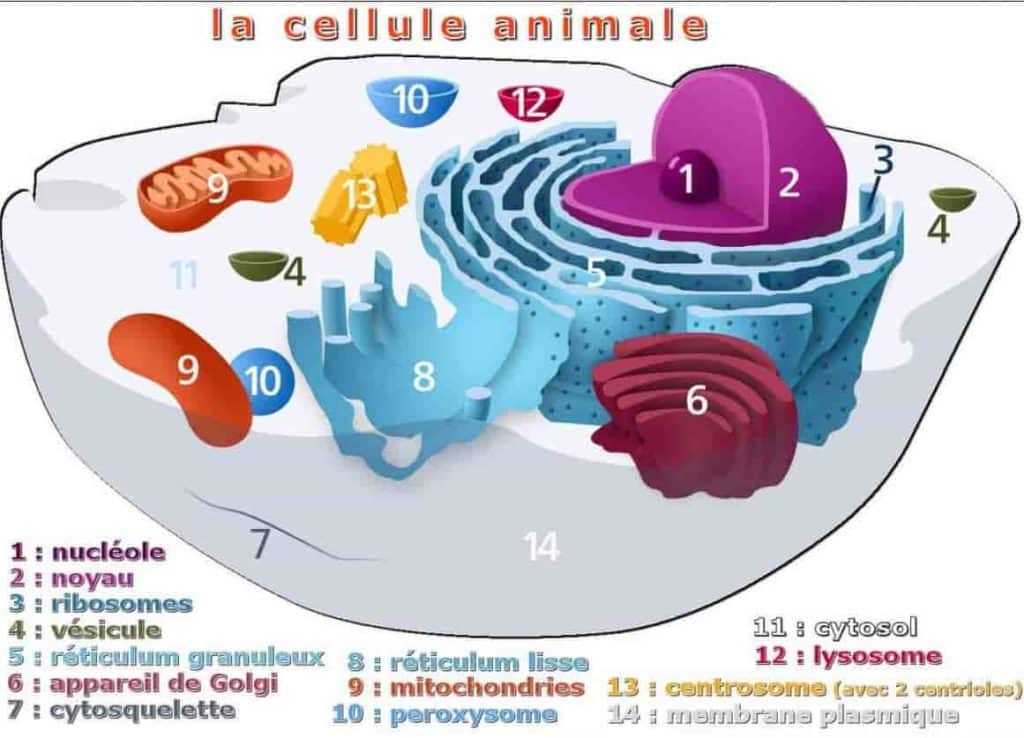
Diagram of the structure of an animal cell. This cell wall disappeared with evolution, and animal cells have developed with the most advanced cells, tissues, and organs that are more specialized in their function. Nerves and muscles are such types that help in locomotion, mobility, and performing other functions.
Functioning of the animal cell
The plasma membrane controls the movement of molecules in and out of the cell. It is the outermost layer of the cell, and it also protects the internal organelles.
Mitochondria are also called the cell’s powerhouse because ATP (adenosine triphosphate) is produced by the oxidation of glucose and fatty acids.
Lysosomes degrade the substances engulfed by the cell and eliminate cellular membranes and organelles. They are considered the digestive tract of the cell.
The nuclear envelope is the double-layered membrane that protects the contents of the nucleus.
The nucleus contains the hereditary material and is filled with chromatin composed of DNA and proteins.
The endoplasmic reticulum has two types, the smooth endoplasmic reticulum and the rough endoplasmic reticulum. In the smooth endoplasmic reticulum, lipids are synthesized and hydrophobic compounds are detoxified. In the rough endoplasmic reticulum, the synthesis of proteins occurs.
The Golgi apparatus processes and sorts lysosomal proteins, secreted proteins, and membrane proteins synthesized on the rough endoplasmic reticulum.
The secretory vesicle stores the secreted proteins and fuses with the plasma membrane to release their contents.
The peroxisome is a single-membrane cellular body. Oval or spherical, it contains the enzyme catalase. Peroxisomes detoxify molecules and break down fatty acids to produce acetyl groups for biosynthesis.
The cytoskeleton forms the network and bundles that support the cell membrane and help organize organelles and support cell movement. The cellular matrix is collectively called cytosol. The cytosol is a compartment containing several metabolites, enzymes, and salts in a gel-like aqueous medium.
Microvilli increase the surface area for nutrient absorption from the surrounding environment.
Different types of animal cells
- Skin cells are found in the cutaneous and epidermal layers; the skin acts in protecting internal parts, preventing excessive water loss through dehydration, perception, and in transmitting sensation.
- Bone cells are responsible for forming the bones and skeleton of animals. There are many types of bone cells, and their main function is to provide structural support and assist in body movement.
- Muscle cells or myocytes serve to move the body. They also help protect the delicate organs of the body.
- Blood cells act as carriers in the body that transport hormones and nutrients. Primarily, blood carries oxygen to various tissues in the body and also helps retrieve the carbon dioxide they contain. Blood cells are also called hematopoietic cells.
- Nerve cells are specialized cells designated to send impulses or information. These are signals or messages that help the body connect and perform synchronized functions based on the external environment. These electrochemical signals are sent by the central nervous system and sensory receptors.
Main differences between plant and animal cells
The fundamental and functional unit of life is the cell, which can be prokaryotic or eukaryotic, unicellular or multicellular.
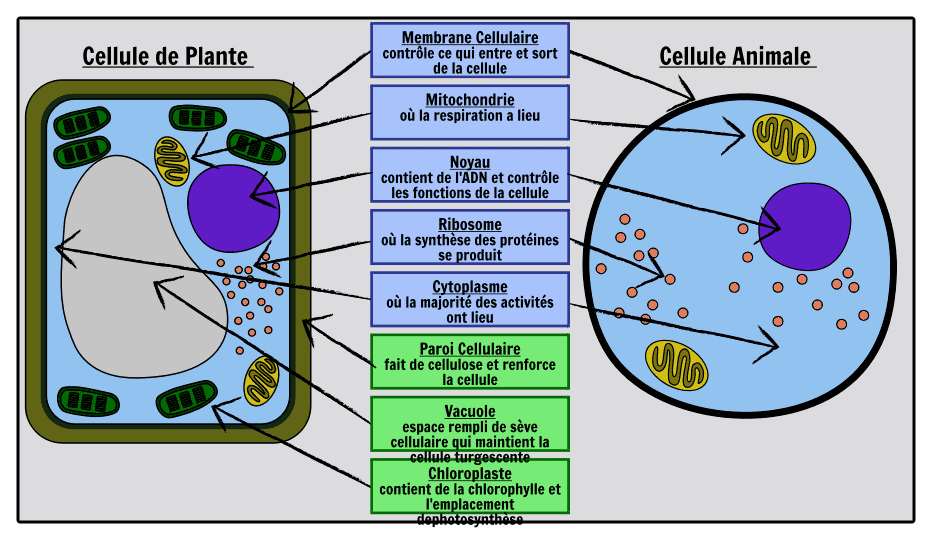 Comparative diagram of a section of a plant cell Comparative diagram of a section of a plant cell (left) and an animal cell (right)
- Plant cells possess certain organelles such as the cell wall, chloroplasts, and vacuoles that are absent in animal cells.
- Plant cells are generally larger, fixed, and rectangular, while animal cells are relatively smaller, irregular, and round.
- A nucleus is present in both cells, but in the plant cell it is located to one side while it is present at the center of the animal cell.
- Centrosomes/centrioles, cilia, desmosomes, and lysosomes are organelles absent in plant cells, while they exist in animal cells.
- Plastids, glyoxysomes, plasmodesmata, and chloroplasts (for food preparation) are features present in plant cells but not present in animal cells.
- There is a large vacuole present in plant cells, but many small vacuoles are present in animal cells.
- Mitochondria, if present in the plant cell, are the least numerous, while in animal cells, they play an important role and help in energy production.
- The storage of energy is done through the chloroplast in plant cells, which is absent in animal cells.
- The reserve food material is starch in plant cells and glycogen in animal cells.
- The synthesis of nutrients such as amino acids, vitamins, and coenzymes is carried out by plant cells, but animal cells are unable to do so.
- Cytokinesis occurs by cell plate only in plant cells, while in animal cells, it occurs by furrows or constrictions.
Common points between animal cells and plant cells
Plant and animal cells, although different in many ways, have similarities.
- Both plant and animal cells are eukaryotic cells.
- Both have a cell membrane.
- A well-defined nucleus is present.
- Both cells contain a Golgi apparatus.
- One of the most important parts of the cell is the cytoplasm, which is also present in both.
- Ribosomes are present in both plant and animal cells.
Finding
Plants are called autotrophs, while animals are heterotrophs. In this article, we discussed the structures and functioning of plant and animal cells, their types, as well as the essential points that distinguish them. All eukaryotic cells, whether plant or animal, contain a nucleus and few organelles in common and similarities in their function. The reason for this difference may be the mode of nutrition since animals are heterotrophs. Another reason is related to the evolution of cells developed as needed.
Tag: animal and plant cell