
But what is a sound?
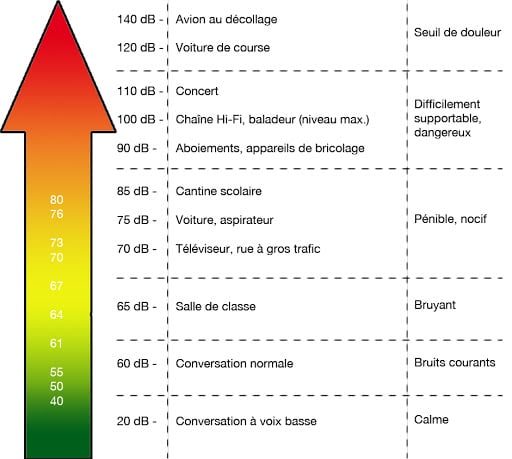
source Cochléa Sound is a sound wave. This wave is transformed into an electrical signal for the brain. A sound can be loud or soft. We talk about intensity. It is measured in decibels. A sound can also be severe or high-pitched. We talk about frequency, in hertz.
Normal functioning of hearing
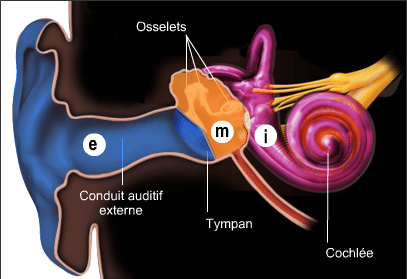
Source Cochléa The ear consists of three parts. In blue: the outer ear with the pinna and the external auditory canal. In orange: the middle ear with the chain of ossicles (hammer, anvil, and stirrup). In pink: the inner ear with the cochlea, shaped like a snail, and the vestibular apparatus, responsible for balance. But then, what is deafness?
Conductive hearing loss
This type of deafness concerns the outer or middle ear. Sound is not transmitted properly, either because the canal is blocked (in the case of an ear infection, for example), or due to anatomical malformations or muscular problems. Hearing loss can be up to 60 decibels (dB). Treating the ear infection is possible, and the deafness is then temporary.
Sensorineural deafness
In sensorineural deafness, the cells inside the cochlea do not function well. The auditory nerve may also be damaged. We have auditory capital for life; damaged cells cannot be replaced or repaired. The ENT specialist can prescribe hearing aids at any age so that children hear better.
Degree of hearing loss
To know what Nathan hears or does not hear, the ENT specialist suggests conducting an audiogram. We examine whether Nathan has mild, moderate, severe, or profound hearing loss. The intensity of speech is about 60 dB, but you need more decibels to understand a conversation. The impact on language is therefore not the same depending on the degree of deafness.
- A mild loss (between 21 dB and 40 dB) means that the person perceives speech from a normal voice. A low or distant voice is harder to hear.
- Moderate loss (between 41 dB and 70 dB) means that we perceive loud speech; you need to look at the lips to understand.
- Severe loss (between 71 and 90 dB): you hear someone shouting, but we do not understand.
- Profound loss (from 91 to 119 dB): we hear very loud noises but do not hear speech.
- From 120 dB, we talk about profound deafness: nothing is perceived.
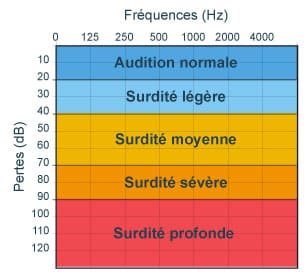
source Cochléa According to the audiogram, Nathan has moderate hearing loss. He does not perceive all speech sounds and is bothered by noise.
The care pathway
Nathan will see the ENT specialist to measure his hearing. He will then be referred to a speech therapist to assess the impact of deafness on language development. The speech therapist receives deaf children from a very young age. Indeed, screening for deafness can be possible from the maternity ward.
The ENT specialist will offer Nathan’s parents a hearing aid regardless of the hearing loss. The device helps compensate for hearing loss; it does not cure deafness. The ENT specialist gives the parents a medical prescription to go to the hearing aid specialist. The latter will be able to provide hearing aids. They allow you to amplify sound like a microphone. They are worn on the ear all day long.
In cases of severe to profound deafness
In cases where deafness affects both ears (bilateral) and is severe to profound, hearing aids will not be sufficient. The child will not hear language well enough. He will be received with his family at a hospital in a referral center. He will be welcomed by a multidisciplinary team (ENT, psychologist, speech therapist). The ENT specialist may offer a cochlear implant. This procedure is done in the hospital and requires surgery. The cochlear implant has two parts: an external processor, worn on the ear, that captures and analyzes sounds. These sounds are transmitted to the internal processor implanted under the skin, which in turn transmits them electrically directly to the auditory nerve. The sound no longer passes through the outer and middle ear.
The speech therapist supports the deaf child and his parents. He assists with the fitting of devices, offers auditory education, introduces the sound world, and supports the development of speech and language.
Tag : what is an ENT